Alexander Graham Bell Inventions Alexander Graham Bell Family Members
Alexander Graham Bell, teacher of the deaf, inventor, scientist (built-in 3 March 1847 in Edinburgh, Scotland; died 2 August 1922 near Baddeck, NS). Alexander Graham Bell is generally considered second simply to Thomas Alva Edison among 19th- and 20th-century inventors. Although he is best known as the inventor of the first practical telephone, he also did innovative work in other fields, including aeronautics, hydrofoils and wireless communication (the "photophone"). Moreover, Bell himself considered his work with the deaf to be his most important contribution. Born in Scotland, he emigrated to Canada in 1870 with his parents. Bong married American Mabel Hubbard in 1877 and became a naturalized American citizen in 1882. From the mid-1880s, he and his family spent their summers near Baddeck on Cape Breton Island, where they built a big home, Beinn Bhreagh. From then on, Bell divided his fourth dimension and his research between the United States and Canada. He died and was cached at Baddeck in 1922.
Alexander Graham Bell, teacher of the deaf, inventor, scientist (born 3 March 1847 in Edinburgh, Scotland; died 2 Baronial 1922 near Baddeck, NS). Alexander Graham Bong is mostly considered second only to Thomas Alva Edison amongst 19th- and 20th-century inventors. Although he is best known as the inventor of the first practical telephone, he also did innovative piece of work in other fields, including aeronautics, hydrofoils and wireless communication (the "photophone"). Moreover, Bong himself considered his work with the deaf to exist his most of import contribution. Built-in in Scotland, he emigrated to Canada in 1870 with his parents. Bell married American Mabel Hubbard in 1877 and became a naturalized American citizen in 1882. From the mid-1880s, he and his family unit spent their summers nigh Baddeck on Greatcoat Breton Isle, where they built a large home, Beinn Bhreagh. From then on, Bell divided his time and his research between the Us and Canada. He died and was buried at Baddeck in 1922.
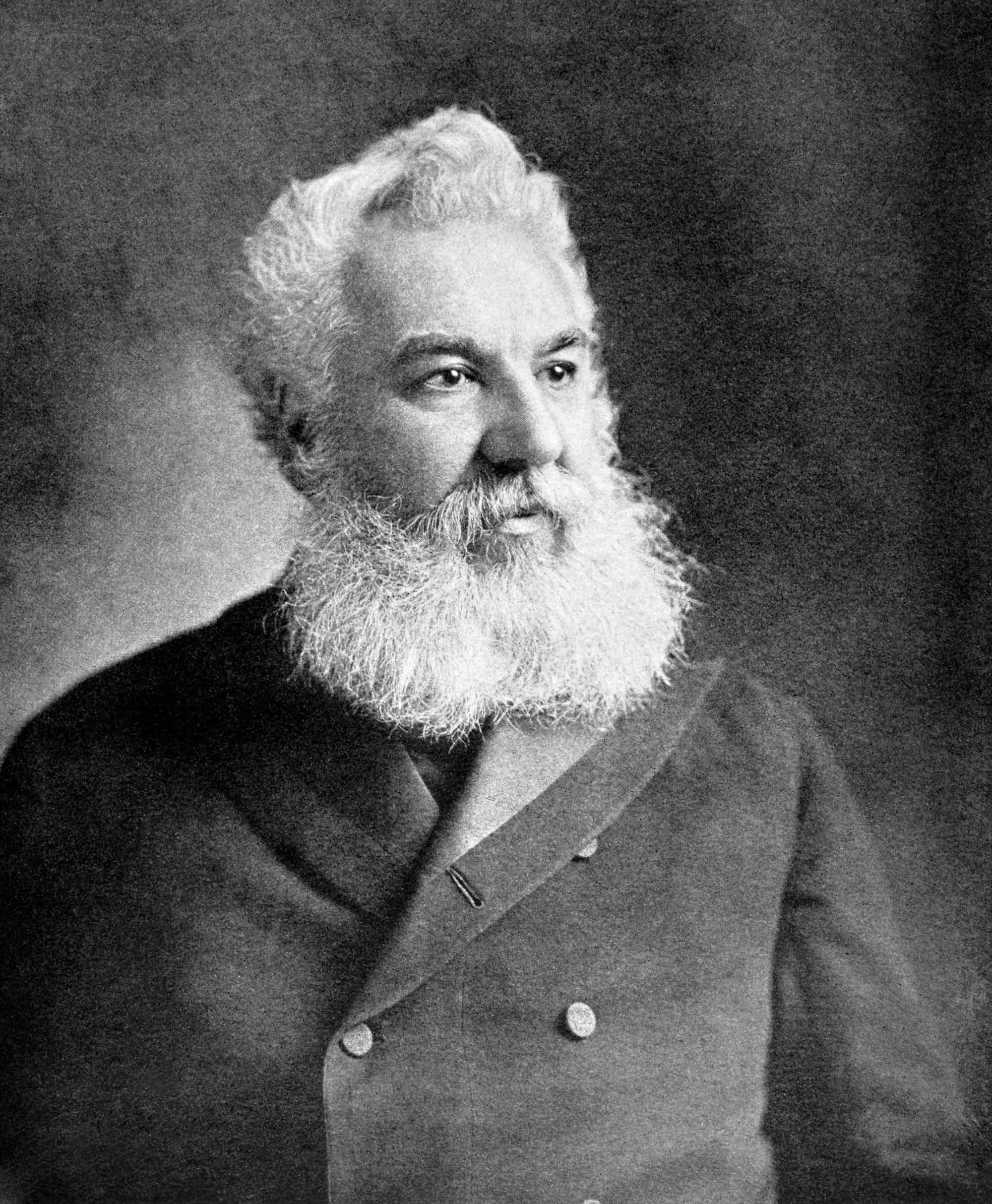
Bell's Childhood and Family Groundwork
Alexander Bell was born in 1847 in Edinburgh, Scotland, to female parent Eliza Grace Symonds and male parent Alexander Melville Bell. He was the center of three children, between elderberry brother Melville James (born 1845) and younger blood brother Edward Charles (born 1848). Dissimilar his brothers, Alexander was not given a middle name at birth, but added "Graham" in 1858.
Both his father and grandfather were experts in speech and elocution (the skill of clear, expressive speech, focusing on pronunciation and articulation). His grandfather — also named Alexander — had done pioneering work in oral communication impediments and in 1835 published The Practical Elocutionist, which used symbols to bespeak word groupings. This would be the basis of a organization of "visible speech" developed by Alexander Melville Bong, which he (and later his son) would employ in teaching the deafened.
The Bong children received their early schooling at home from both their father and their mother, an accomplished painter who was partially deaf. Every bit a teenager, Alexander Bell attended the Royal High School in Edinburgh. Although Bong loved both music and science, he was an indifferent student and decumbent to daydreaming. Outside school, however, he demonstrated a great mind. In 1858, at historic period 12, he invented a procedure to remove the husks at a flour manufacturing plant owned by his friend'due south male parent, adding wire brushes to an existing machine.
At historic period 15, Bell was sent to London, where he lived for a twelvemonth with his grandfather. Effectually this time, Bell met telegraph researcher Charles Wheatstone, who had produced a version of Wolfgang von Kempelen'southward Speaking Car, an instrument that mechanically produced human voice communication. This inspired Bell and his brother Melville to develop their own "talking larynx" —an artificial windpipe that produced a pocket-sized number of recognizable words when air was blown through it.
Bell began instruction elocution at age 16, while also researching the physiology of spoken communication. His work and then impressed phonetician Alexander John Ellis, that he invited the young man to bring together the Philological Society in 1866. The post-obit year, he began education his begetter's "visible speech" method to deafened students in London, where the family unit was and then located. Sadly, Bell'south younger brother Edward died the same year of tuberculosis. Bell took anatomy and physiology at Academy College in London from 1868 to 1870, but didn't finish his degree.
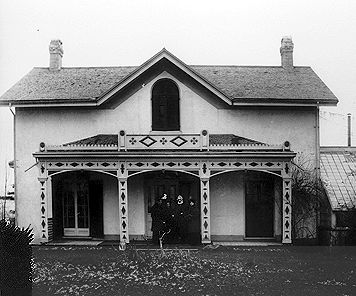
In May 1870, his older brother Melville died of tuberculosis, and his parents decided to go out Britain, fearing that their remaining son would succumb to the disease equally well. In August 1870, he and his parents (and his widowed sister-in-law) moved to Canada and settled in Brantford, Ontario. Non long before they left, the family dined with Alexander Ellis, who pointed Bong towards the piece of work of German scientist Hermann von Helmholtz — work that inspired Bell's interest in electromagnetism and electricity and his belief that people would soon be able to "talk by telegraph."
Teacher of the Deaf
In 1871, Bong accepted a position teaching at a school for the deaf in Boston, Massachusetts, starting time a long career as an educator of the deaf in the United states of america. He spent summers with the family at Brantford, Ontario, retreating there to residuum when his tendency to overwork left him wearied.
Around this time, many American experts believed that deaf people (and then referred to every bit "deafened mutes") could non be taught to speak. The oldest school for the deaf, the American Asylum for the Education and Instruction of the Deaf and Dumb (afterward the American Schoolhouse for the Deafened) in Hartford, Connecticut, exclusively taught sign language. In that location were others, even so, who believed that the deaf could and should exist taught oral skills. This included Gardiner Greene Hubbard, who founded the Clarke Institution for Deaf-Mutes (later the Clarke Schoolhouse for the Deaf) in Northampton, Massachusetts, in 1867.
Bell (similar his male parent) taught "visible speech" to the deaf by illustrating, through a series of drawings, how sounds are made, essentially teaching his students to speak by seeing sound. He helped them go aware of the sounds around them past feeling sound vibrations. One teaching aid was a airship— by clutching i tightly against their chests students could experience sound.
In the bound of 1872, Bell taught at the American Asylum for the Education and Instruction of the Deaf and Dumb in Hartford and the Clarke Institution for Deafened-Mutes in Northampton. That fall, he opened his ain School of Vocal Physiology in Boston, and in 1873, he became a professor of vocal physiology and elocution at Boston University. The same year, he began tutoring Mabel Hubbard, a deaf student who was the girl of Clarke School founder Gardiner Greene Hubbard. Bell was quickly captivated past the young Mabel, who was 10 years his junior (they married in 1877).
When Bell was non teaching, he spent much of his gratuitous time researching the electrical manual of sound, eventually leading to the evolution of the telephone (run across below). However while he is best known for his inventions, he remained committed to didactics of the deaf throughout his life. In 1887, for example, he established the Volta Bureau for research, information and advocacy for the deaf in Washington, DC. He was likewise president of the American Association for the Promotion of the Teaching of Speech to the Deaf (now the Alexander Graham Bell Association for the Deaf and Difficult of Hearing), which was founded in 1890.
Bell besides had a close relationship with Helen Keller, whom he met in 1887; the ii communicated ofttimes and Keller visited Bell's home several times. Keller'south The Story of My Life (1903) was dedicated to Bong, "who has taught the deafened to speak and enabled the listening ear to hear speech from the Atlantic to the Rockies."
The Multiple Telegraph
Much of Bell'due south piece of work can be described every bit a series of observations leading 1 to some other. His combined interest in audio and communication developed his interest in improving the telegraph, which ultimately led to his success with the telephone.
When Bong began to experiment with electric signals, the telegraph had existed for more than than 30 years. Although it was a successful arrangement, the telegraph was limited to receiving and sending one message at a time, using Morse lawmaking. Past the early 1870s, a number of inventors (including Thomas Edison and Elisha Gray) were working on a telegraph that that could transmit simultaneous messages.
Fifty-fifty before coming to Canada, Bell had been intrigued by the thought of using a well-known musical phenomenon to transmit multiple telegraph messages simultaneously. He knew that everything has a natural frequency (how quickly something vibrates) and that a sound's pitch relies on its frequency. By singing into a pianoforte he discovered that varying the pitch of his voice fabricated different pianoforte strings vibrate in return. His observations led to the idea of sending many different messages along a single wire, with identical tuning forks tuned to unlike frequencies at either finish to send and receive, a organization he called the "harmonic telegraph."
By October 1874, Bell's research had been so successful that he informed his future begetter-in-law, Gardiner Greene Hubbard, about the possibility of a multiple telegraph. Hubbard resented the Western Union Telegraph Company's communications monopoly and gave Bell the financial backing he needed. Hubbard was joined by leather merchant Thomas Sanders, who was also the father of one of Bell'southward deaf students in Boston. Bell worked on the multiple telegraph with a young electrician, Thomas Watson. At the aforementioned fourth dimension, he and Watson were exploring the possibility of a device that would transmit speech electrically.
Development of the Phone
Co-ordinate to Bong, inspiration struck on 26 July 1874 during a summer visit to Brantford. While watching the currents in the Grand River, Bell reflected on audio waves moving through the air and realized that with electricity, "it would be possible to transmit sounds of any sort" past decision-making the intensity of the current. Based on his new insight, he sketched a primitive telephone.
The get-go major breakthrough occurred on 2 June 1875. Bell and Watson were preparing an experiment with the multiple telegraph past tuning reeds on three sets of transmitters and receivers in different rooms. Ane of Watson'due south reeds, affixed too tightly, was stuck to its electromagnet. With the transmitters off, Watson plucked the reed to free it, and Bell heard a twang in his receiver. They had inadvertently reproduced sound and proved that tones could vary the forcefulness of an electric current in a wire. The next stride was to build a working transmitter with a membrane that could vary electronic currents and a receiver that could reproduce the variations in aural frequencies. Inside days Watson had built a primitive telephone.
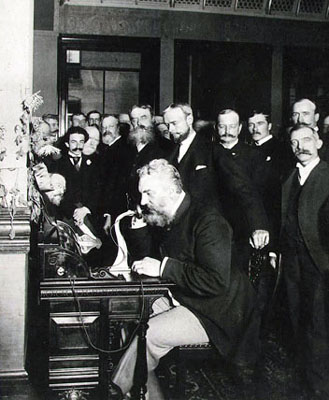
Bell continued inquiry on the telephone, and on 14 February 1876 Hubbard submitted an application to the U.s.a. Patent Office on his behalf for an undulatory current, variable resistance liquid transmitter. Hours later, Elisha Gray's attorney submitted an application for a similar transmitter. On vii March, Bell received Patent No. 174,465, "Improvements in Telegraphy." Although he hadn't yet succeeded in edifice a working phone (neither had Gray), the patent established intellectual and commercial rights to the technology. He and Watson continued their work, and on 10 March 1876, Bell spoke into the first telephone, uttering the now-famous instruction to his banana: "Mr. Watson — come here — I want to see you lot."
Bell'south work culminated in not simply the birth of the telephone, but the death of the multiple telegraph. The communications potential of being able to "talk with electricity" overcame anything that could be gained by simply increasing the chapters of a dot-and-dash arrangement.
Bell, Hubbard, Sanders and Watson formed the Bong Telephone Company on 9 July 1877. The following twenty-four hour period, Bell gave his begetter, Melville, most of his Canadian rights to the telephone. On 11 July, he married Mabel Gardiner Hubbard (1857–1923) and embarked on a yearlong honeymoon in Europe. Over the next several years, the Bell company fought and won hundreds of phone patent lawsuits in the courts, making Bell rich by age 35. By that point, however, he had largely withdrawn from the concern and turned to other interests.
Volta Laboratory
Bell might easily have been content with the financial success of his invention. His many laboratory notebooks reveal the depth of the intellectual curiosity that drove him to learn and create. In 1880, Bell received the Volta Prize from the French government, in recognition of his achievements in electric science (particularly the invention of the phone). Bell used the prize money to institute the Volta Laboratory Association with his cousin, Chichester A. Bell, and Charles Sumner Tainter. Based in Washington, DC (where the Bell family at present lived), the laboratory was defended to acoustic and electrical research.
Photophone
In 1880, Bell and Tainter adult a device they chosen the "photophone," which transmitted audio on a beam of calorie-free. In February, they successfully sent a photophone message nearly 200 metres between two buildings. Bell considered the photophone "the greatest invention [he had] ever made, greater than the phone." Although the photophone was not commercially feasible, it did demonstrate that one could employ calorie-free to transmit sound. Their invention is therefore considered to exist the precursor of fibre optics and wireless communications.
Metal Detector
In July 1881, Bong and Tainter adult an electrical bullet probe, in an attempt to save the life of US President James A Garfield, who had been shot. The probe was unable to find the bullet and Garfield eventually died of infection. Notwithstanding, Bong continued to tinker with his device, and demonstrated it a few weeks later in New York. The device was commercially produced past a Dr. John H. Girdner and used by military surgeons during several wars over the side by side few years.
Graphophone
Bell, his cousin Chichester A. Bong, and Tainter likewise developed the graphophone, improving on the phonograph patented past Thomas Edison in 1878. Edison'southward phonograph had a cylinder covered in tinfoil, upon which a rigid stylus cut a groove. Bell and his colleagues used waxed-coated cylinders, which produced a amend recording, and a floating instead of a rigid stylus; they besides added an electric motor instead of a manual crank. The group received patents in 1886, and founded the Volta Graphophone Company with James Saville and Charles J. Bell. The post-obit year, the American Graphophone Company was established to manufacture the graphophones, i of which became popular as a dictating auto. In 1888, Jesse Lippincott licensed the patents, with Bell using his share of the proceeds to establish the Volta Bureau.
Aerodromes and Hydrodromes
From the mid-1890s, Bong's primary research interest was aviation and flight. In 1907, Bell and his wife co-founded the Aerial Experiment Clan (AEA) in partnership with J.A.D. McCurdy, F.W. Baldwin and a few other young engineers, such as Glenn H. Curtiss, an American builder of motorcycle engines, and Lieutenant Thomas Selfridge, who acted as observer from the American army. The team separate their time between the United States and the Bell estate at Baddeck.
The association's first experimental flight was conducted on 6 December 1907. The examination shipping, the Cygnet I, was a large, tetrahedral kite placed on pontoons that attained a pinnacle of 51 metres and stayed in the air for seven minutes. In 1908, the association congenital and flew several aircraft, with varying success. They achieved a record on 4 July 1908 when Curtiss flew the June Problems to become the first aircraft to fly one kilometre in the western hemisphere, for which the association was awarded the Scientific American Trophy.
On 23 February 1909, McCurdy flew the Argent Sprint at Baddeck — what is generally accepted every bit the get-go powered, heavier-than-air flight in Canada (the first such flight in history was achieved in 1903 by American inventors Orville and Wilbur Wright at Kitty Hawk, North Carolina).

Although the AEA disbanded in 1909, Baldwin and McCurdy connected to work as the Canadian Aerodrome Visitor (CAC) for another year, supported by Bell. The CAC hoped to convince the Canadian regime to invest in their airplanes, demonstrating both the Silver Sprint and the Baddeck No. I at Camp Petawawa. However, the government lost interest and the CAC dissolved in 1910. (Run into also Alexander Graham Bong, Aviation Pioneer.)

Bong and Baldwin continued work at Baddeck, focusing on "hydrodromes" or hydrofoils (the Bong team had begun work on hydrodromes in 1908). In 1919, i of their hydrofoils, the HD-4, fix a globe h2o-speed tape of 114.04 km/h, at a time when the world'due south fastest steamships travelled at only 48 km/h. That tape was not approached past whatever other gunkhole for more a decade.
Commitment to Scientific Research
Bong worked on a number of different inventions, including the audiometer and a "vacuum jacket" (a precursor of the iron lung) following the death of his babe son in 1881. He likewise researched the desalination of seawater and attempted to breed a "super race" of sheep at Baddeck. Bong supported the experiments of others as well, funding the early atomic experiments of A.Grand. Michelson, amidst other projects. He also supported the journal Science, which would become America's foremost journal of scientific research.
Bong helped found the National Geographic Society in 1888 and was its second president (1898–1903). The first president of the club was his father-in-law, Gardiner Greene Hubbard. Bong wanted the club's magazine to appeal to the general public, not just to professional geographers and geologists, and promoted the use of photography in the magazine. In 1899, he hired Gilbert Hovey Grosvenor, who would go editor-in chief in 1903 and president of the society in 1920. Grosvenor (who married Bong's daughter, Elsie May, in 1900) was a pioneer of photojournalism. Under his leadership, the National Geographic Magazine became widely popular, increasing its circulation from under a k readers to more than 2 million.
Family
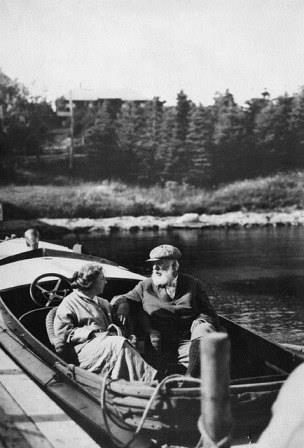
Bell married Mabel Gardiner Hubbard (1857–1923) in July 1877. Mabel Bell shared her husband's scientific interests, and was co-founder (and funder) of the Aerial Experiment Association. She also undertook her ain horticultural experiments. They enjoyed a close relationship with both sets of parents. Bell worked closely with his father-in-law, while his own parents moved to Washington, DC, to be close to their son and his family unit.
The Bells had ii daughters — Elsie May Bell (1878–1964) and Marian Hubbard "Daisy" Bell (1880–1962) — and ii sons, Edward (1881) and Robert (1883), who both died in infancy. Elsie married Gilbert Grosvenor, who would become editor-in-chief of the National Geographic Society Magazine, and had vii children. Daisy married botanist David Grandison Fairchild, whom she met through the National Geographic Guild; the couple had iii children.
Decease and Significance
Bell died in 1922 at Beinn Bhreagh, due to complications from diabetes. Best known as the inventor of the telephone, he spent much of his life teaching the deafened and considered it his almost important contribution. Moreover, the telephone was but one of Bell's many inventions and innovations. In fact, he refused to have i in his own study, equally he found information technology intruded on his scientific work. Fittingly, all telephones in Northward America were silenced for a brief time at the conclusion of his funeral. His wife, Mabel, died in Jan 1923, just five months later on. Both were interred in Nova Scotia, on a colina overlooking Baddeck Bay. The Beinn Bhreagh manor is still owned by descendants of the family unit and in 2015, it was declared a provincial heritage property.

nordfouldlairity1967.blogspot.com
Source: https://www.thecanadianencyclopedia.ca/en/article/alexander-graham-bell

Postar um comentário for "Alexander Graham Bell Inventions Alexander Graham Bell Family Members"